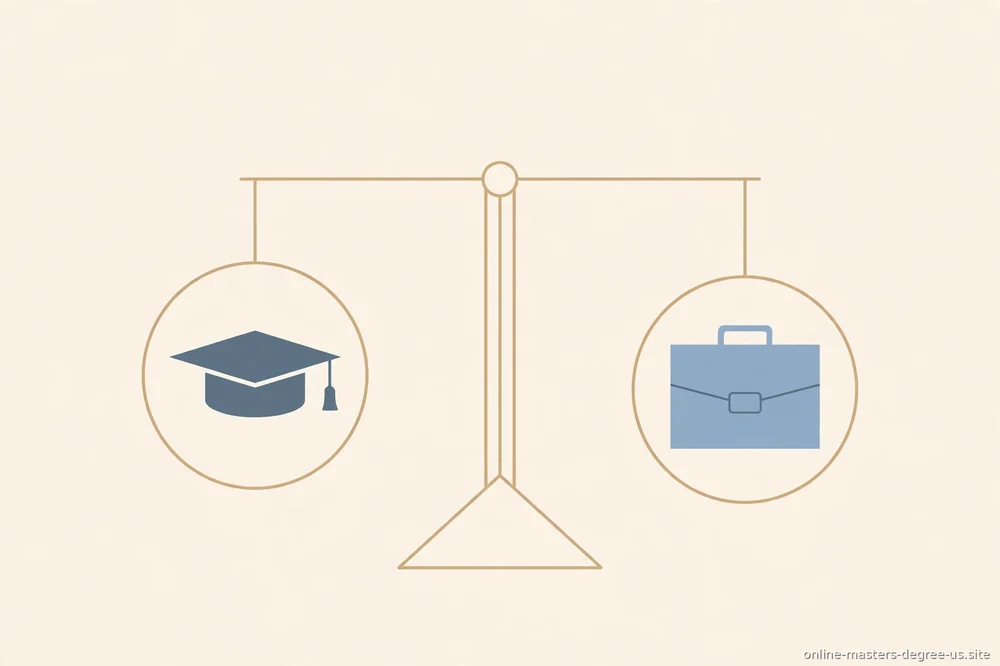
Do employers respect online master's degrees? The honest answer: most evaluate the credential, the school's accreditation, and your skills — not the delivery format.
Do employers respect online master's degrees? In most cases, yes — employers evaluate the credential itself, the accreditation standing behind it, and what you can actually do, rather than whether you attended lectures in person or online. The skepticism that once surrounded online degrees has faded considerably, though honest nuances remain worth understanding before you enroll.
The Short Answer, With Honest Nuances
The straightforward answer is that an online master's degree from an accredited institution is generally treated as a legitimate graduate credential. Hiring managers care about whether you have the degree, whether the institution is properly accredited, and whether your skills match the role. The delivery format — online versus on-campus — is usually a secondary consideration, if it comes up at all.
The nuances matter, though. First, the reputation that counts is the institution's, not the modality's: a degree from a well-regarded accredited university carries weight regardless of format, while a degree from an institution employers have never heard of raises questions regardless of format. Second, some fields with heavy hands-on or clinical components expect in-person training for those specific skills, and employers in those fields will look closely at how practical competencies were developed. Third, individual hiring managers vary — most are format-neutral, a minority retain old biases. Understanding these nuances lets you choose a program and present your credential strategically rather than anxiously.
Myth vs. Reality
Several persistent myths distort this conversation. Clearing them up helps you evaluate programs with a level head.
Myth: Employers can always tell — and always care — that a degree was earned online. Reality: Diplomas and transcripts from most universities do not distinguish between online and on-campus completion; the credential awarded is the same. And even when employers know the format, most treat it as neutral information. What they probe in interviews is your knowledge, your experience, and your fit — not your lecture attendance method.
Myth: Online degrees are easier, so employers discount them. Reality: Employers who are familiar with online graduate programs know the coursework is comparable in rigor — the same readings, papers, projects, and assessments. If anything, completing a demanding degree while working full-time signals time management and discipline that many hiring managers respect. The "easier" stereotype dates from the early days of online education and describes the weakest programs, not the format itself.
Myth: You need to hide the online format on your resume. Reality: There is generally nothing to hide, and attempting to obscure your education history creates worse problems than transparency. List the degree and institution plainly. If the program included distinctive elements worth highlighting — a capstone project, applied research, collaboration with working professionals across industries — those strengthen your resume far more than any format discussion.
Myth: All online programs are viewed equally. Reality: This is the myth that actually matters, because its inverse is true: programs are judged very differently based on accreditation and institutional reputation. The format is not the differentiator — legitimacy is. Which brings us to the factor that matters most.
Accreditation: The Factor That Actually Matters
Do Employers Respect Online Master’s Degrees?
If employers look past format, what do they look at? Accreditation first. Institutional accreditation — recognition by an accrediting body acknowledged by the U.S. Department of Education — is the baseline signal that a degree represents genuine academic work. Many employers, and virtually all government positions and licensed professions, treat accreditation as a threshold requirement. A degree from an unaccredited institution is the scenario where employer skepticism is both real and justified.
Programmatic accreditation matters in fields that have it — specialized accrediting bodies for areas like business, nursing, education, engineering, and public health. If your field has one, check whether programs you are considering hold it, using official directories rather than marketing claims. Employers in regulated fields often know exactly which accreditations they expect.
Beyond formal accreditation, employers weigh institutional familiarity. A university with an established reputation — one whose name a hiring manager recognizes — confers credibility automatically. This is not about prestige rankings; it is about the simple fact that known institutions are trusted institutions. When researching programs, consider how the university is perceived in your target industry and region, and verify everything through official sources.
What Employers Actually Evaluate
Step back from the degree-format question and consider what hiring decisions actually turn on. Employers evaluate a bundle: your degree (does it check the required box?), your skills (can you do the work?), your experience (have you done similar work?), and your professional presence (interviews, portfolio, references). The degree opens doors; what walks through them is everything else.
This is liberating news for online students, because the factors you control most — skills, portfolio, experience — are format-independent. An online student who builds a strong capstone project, contributes substantively to collaborative work, and develops relationships with instructors and peers (see our guide to building connections as an online graduate student) graduates with the same employable bundle as an on-campus peer. In some respects the online student's bundle is stronger: years of concurrent work experience plus a graduate degree is a combination many employers actively seek.
For career changers, the degree's signaling value is highest: it certifies new-field competence to employers who cannot otherwise assess it. For those advancing within a current field, the degree often functions as a promotion qualifier — and here, format matters least of all, because your employer already knows your work.
How to Present Your Online Degree With Confidence
Do Employers Respect Online Master’s Degrees?
Present the degree plainly and lead with substance. On your resume: degree title, field, university name, graduation year — the same format anyone uses. No asterisk, no explanation, no apology. If asked about the online format in an interview, answer matter-of-factly and pivot to what the experience built: "I completed the program online while working full-time, which meant managing a demanding workload independently — my capstone project on [topic] is a good example of that work."
Prepare two or three concrete stories from your coursework: a difficult project, a collaboration across time zones, a piece of analysis you are proud of. Specific stories demonstrate competence far more convincingly than any credential discussion. And gather evidence as you go — portfolio pieces, strong project work, recommendation letters from instructors who know your abilities. These artifacts speak in every format.
One more consideration: if you are pursuing a field-specific degree, such as education, the curriculum areas employers expect are well established. Our overview of what an online master's in education covers in concept can help you understand which competencies your program should be building — and which to highlight to employers.
When the Format Question Still Comes Up
Despite everything above, you may occasionally encounter a hiring manager who asks directly about the online format, sometimes with a skeptical edge. Do not be defensive; be informative. A calm, factual response — describing the program's accreditation, the rigor of the coursework, and what you produced — resolves most skepticism on the spot. Defensiveness suggests you share the doubt; confidence suggests there was never anything to doubt.
In fields where hands-on skill demonstration matters, preempt the question with evidence: portfolios, certifications, practical project outcomes. Show, and the format question answers itself. And remember the broader trend: as online graduates have moved into senior roles across industries over the past decade-plus, the population of hiring managers who themselves hold online degrees keeps growing. Time is on your side here.
The bottom line: choose an accredited program from a reputable institution, do excellent work, build real skills and relationships, and present the credential plainly. Employers respect demonstrated competence backed by a legitimate degree — however the lectures were delivered. Thinking bigger picture, it also helps to understand how a master's degree can affect your career path before you enroll, so the format question sits inside a deliberate plan rather than a defensive one.
Will employers know my degree was earned online?
Usually only if you tell them or if they ask directly — most diplomas and transcripts do not distinguish between online and on-campus completion of the same program. Some employers ask about format out of simple curiosity. There is no reason to be evasive: a straightforward answer that pivots to your skills, projects, and accomplishments handles the question well and moves the conversation to what actually matters.
Do government jobs accept online master's degrees?
Government positions generally evaluate degrees on accreditation rather than delivery format. An online master's from an institutionally accredited university typically satisfies education requirements exactly as an on-campus degree would. Always verify against the specific position's official requirements, since some roles add criteria around field of study, programmatic accreditation, or qualifying coursework — but format itself is rarely the deciding factor.
Does an online MBA or professional master's carry the same weight?
The same principles apply: accreditation, institutional reputation, and your demonstrable skills matter far more than whether lectures were in person or online. In professional fields, employers additionally weigh programmatic accreditation and the practical components of your training — internships, practicums, applied projects. Choose programs whose curriculum builds competencies you can demonstrate, and document your strongest work to discuss in interviews.
Should I mention "online" on my resume or LinkedIn?
There is no requirement to specify format, and most graduates simply list the degree title, field, university, and year — exactly as any graduate would. If the online experience gave you distinctive, marketable strengths, such as managing complex projects independently or collaborating across time zones, those belong in your experience descriptions as skills. Frame them as capabilities, not as disclaimers about how you studied.
What if a specific employer is biased against online degrees?
Individual bias exists but is increasingly uncommon, and it is rarely worth contorting your education choices around the most skeptical hiring manager you might hypothetically meet. Focus on the factors firmly in your control: an accredited program from a reputable institution, strong demonstrable skills, a solid portfolio of work, and genuine professional relationships. A track record of real, verifiable work overcomes format skepticism wherever it still appears.
This site is educational information only — not professional advice. Consult official program sources and qualified advisors about your own situation.